fabiosommer.com
NARCISSUS & DUPLEX
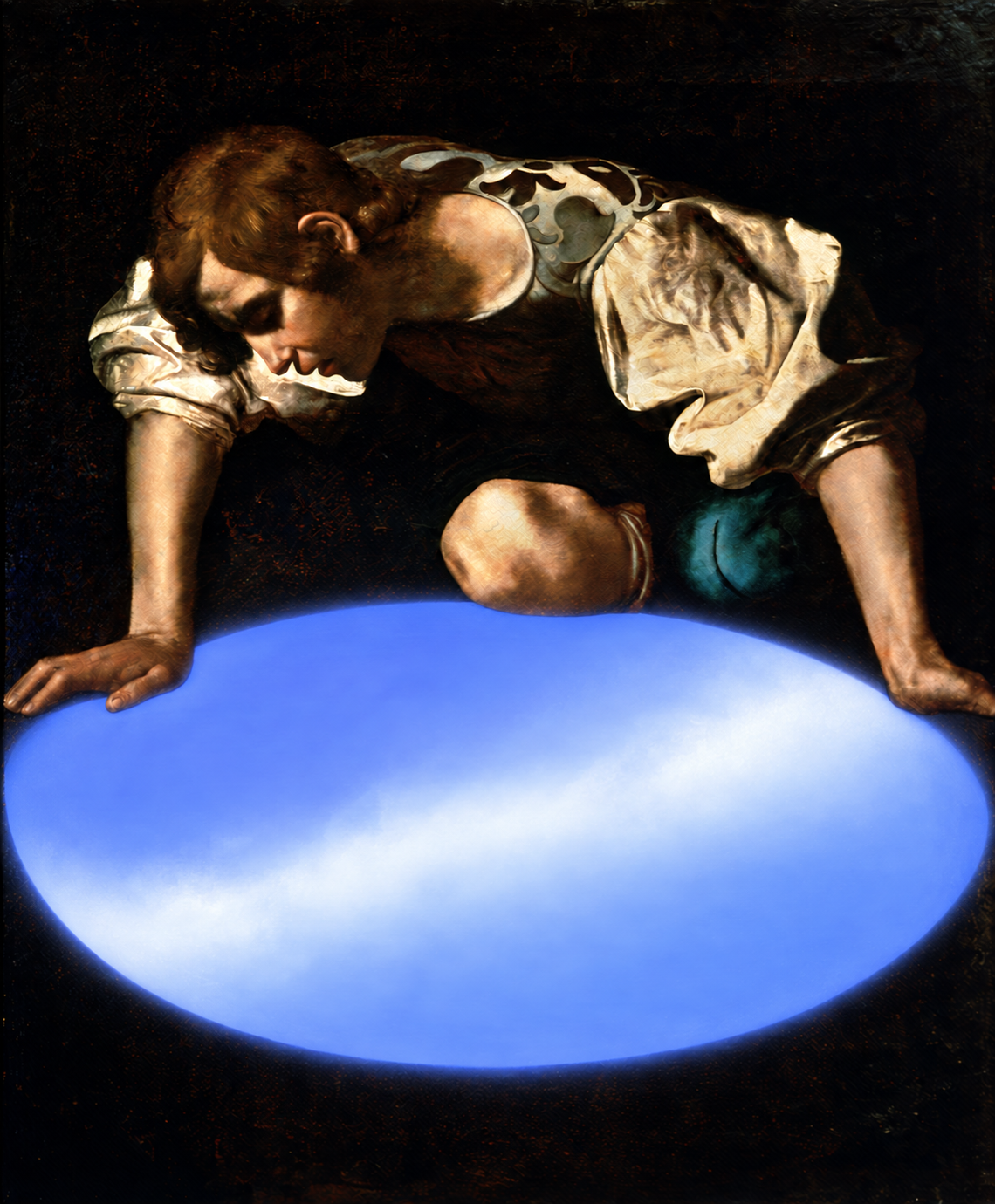
Narcissus & Duplex takes the myth of Narcissus as a starting point and places it within the visual language of contemporary artificial intelligence. In the original story, Narcissus becomes absorbed by his own reflection in water, unable to recognise it as himself. Here, the reflection has disappeared. In its place is the luminous blue form associated with contemporary conversational AI.
-
The work shifts this failure of recognition from the individual towards the collective. Artificial intelligence is often imagined as something fundamentally other: an emerging intelligence outside humanity, simultaneously fascinating and threatening, while being increasingly autonomous. Yet the systems we build are formed from human language, knowledge, culture, habits of thought and accumulated forms of expression. Seen from this perspective, AI can also be understood as a strange collective reflection, shaped from humanity while increasingly encountered as something separate from it.
-
At the scale of the individual, that relationship becomes more intimate. Conversational AI listens, responds, interprets, validates, contradicts and reformulates. It can become a tool for self-reflection while also making that reflection unusually responsive and continuous. The title replaces Echo, Narcissus’s mythological counterpart, with “Duplex”, a technical term for two-way communication. GPT-Live is itself described as full-duplex, allowing speaker and system to listen and speak at the same time. Where Echo could only return what had already been said, Duplex can answer independently.
-
Water runs through the image in several forms. It is the reflective surface upon which the original myth depends, but also the visual language of the contemporary interface that replaces it: soft, fluid, translucent and almost aquatic despite being entirely digital. The natural pool is therefore displaced by a technological simulation of its appearance, turning water from physical substance into interface design. At the same time, water exists behind that interface in a much less visible form, as part of the cooling infrastructure that supports computation and data centres. The same element moves from myth, to screen, to machine.
-
Narcissus & Duplex therefore leaves Narcissus in the familiar posture of self-recognition, but removes the image that once confronted him. What remains is an artificial intelligence built from human expression, encountered as an Other, while the visual trace of the old mirror survives in the interface itself.
-
-
-
Base composition: Narcissus, attributed to Caravaggio, c. 1597–1599
AI image generation: GPT Image 2.5 Sunburst
Interface reference: ChatGPT Live Voice
Technical motif: full-duplex voice interaction
Image intervention: original reflection replaced with contemporary voice-interface visual language